




.webp)
.webp)
.webp)







.webp)

.webp)
When is Secondary Containment Required?

Secondary containment is a critical backup system that catches spills or leaks from a primary container. Generally, strict secondary containment requirements for chemicals apply whenever hazardous liquids are stored in volumes that exceed specific regulatory thresholds or when storage is located near environmental drainage points.
Given these standards, strict adherence to National Environment Agency (NEA) pollution control regulations and Singapore Civil Defence Force (SCDF) fire safety codes is essential to avoid heavy fines and ensure personnel safety.
What is Secondary Containment?
Secondary containment is defined as a protective barrier installed around primary storage vessels. Its primary function is to act as a critical backup system, capturing hazardous material spills and leaks before they reach the floor, drains, or adjacent equipment. By employing containment trays, bunds, or double-walled tanks, facilities create a safety buffer that reduces damage to the facility and prevents environmental contamination in the event of a spill or leak.
General Secondary Containment Requirements for Chemicals
While the Occupational Safety and Health Administration (OSHA) secondary containment requirements and Environmental Protection Agency (EPA) standards govern the United States, Singapore operates under its own regulatory framework. Local facilities must strictly adhere to the mandates of the National Environment Agency (NEA), Singapore Civil Defence Force (SCDF), Ministry of Manpower (MOM), and Public Utilities Board (PUB).
Unlike the US standard (which often cites 100% of the largest vessel or 10% of total volume), best local practices and international guidelines typically recommend a higher safety margin for spill containment requirements.
A standard benchmark for capacity is:
- 110% of the volume of the largest container, or
- 25% of the total volume of liquid stored (whichever is greater).
Beyond calculating volume, a comprehensive strategy for chemical containment must address these critical factors:
- Material Compatibility: The containment unit must be impervious and chemically resistant to the stored liquid to prevent structural failure.
- Fire Safety & Retention: Containment rules specify that facilities must adhere to SCDF regulations (referencing Singapore Standard SS 532), which require spillage control measures and retention basins to manage firefighting water runoff.
- Pollution Prevention: The NEA and PUB require strict preventive measures for hazardous waste secondary containment to ensure that toxic substances do not contaminate land or enter public sewerage systems. This often involves specific approvals for trade effluent discharge.
- Routine Integrity Checks: Systems must be inspected regularly to remain free of cracks, leaks, or debris that could compromise their capacity.
- High-Risk Zones: Strict containment is required in any secondary containment area where chemicals may contact the environment, such as near drains, water sources, or outdoor bulk storage tanks.
How to Determine When Secondary Containment is Required
Identifying your facility's specific secondary containment needs necessitates a systematic review of your inventory and environment.
1. Review Regulatory Thresholds
Start by consulting the specific codes governing your region to confirm mandatory compliance requirements. You must first verify if your inventory is classified as hazardous by reviewing the Safety Data Sheet (SDS). It is the quantity of this hazardous inventory that matters most. Should these stored quantities exceed the volume thresholds set by these bodies, the installation of secondary containment systems becomes a mandatory requirement.
2. Identify Chemical Hazards
Analyze the specific properties of your inventory. Chemicals classified as highly flammable, corrosive, reactive, or toxic pose disproportionate risks. For such high-risk substances, complying with hazardous waste secondary containment standards is almost always mandatory, regardless of the stored volume, because the consequences of even a minor accidental release are severe.
3. Quantify Site Inventory
Calculate the total amount of hazardous materials stored in a specific zone. Perform a thorough inventory of the laboratory facility to ensure compliance with the required capacity guidelines and secondary containment requirements. This step ensures your chosen spill pallets or bunds have the physical capacity to handle a worst-case scenario failure in accordance with local best practices.
4. Assess Environmental Risk
Evaluate the physical location of your storage. Is the storage area near floor drains, high-traffic aisles, or water sources? Any proximity to these features creates a direct pathway for spills to spread rapidly beyond the immediate vicinity.
Storing chemicals near these high-risk zones often requires secondary containment to prevent pollutants from entering the water system or creating slip hazards on walkways.
5. Implementing Safety Best Practices
Finally, look beyond the minimum legal requirements. Operational excellence demands a proactive safety culture aligned with good laboratory practices that employs secondary containment for all liquid storage, even below regulatory limits. Furthermore, use separate containment trays to segregate incompatible chemicals, such as acids and bases, within safety cabinets to prevent dangerous reactions.
Guarantee Lab Compliance: Secure Your Containment Solutions
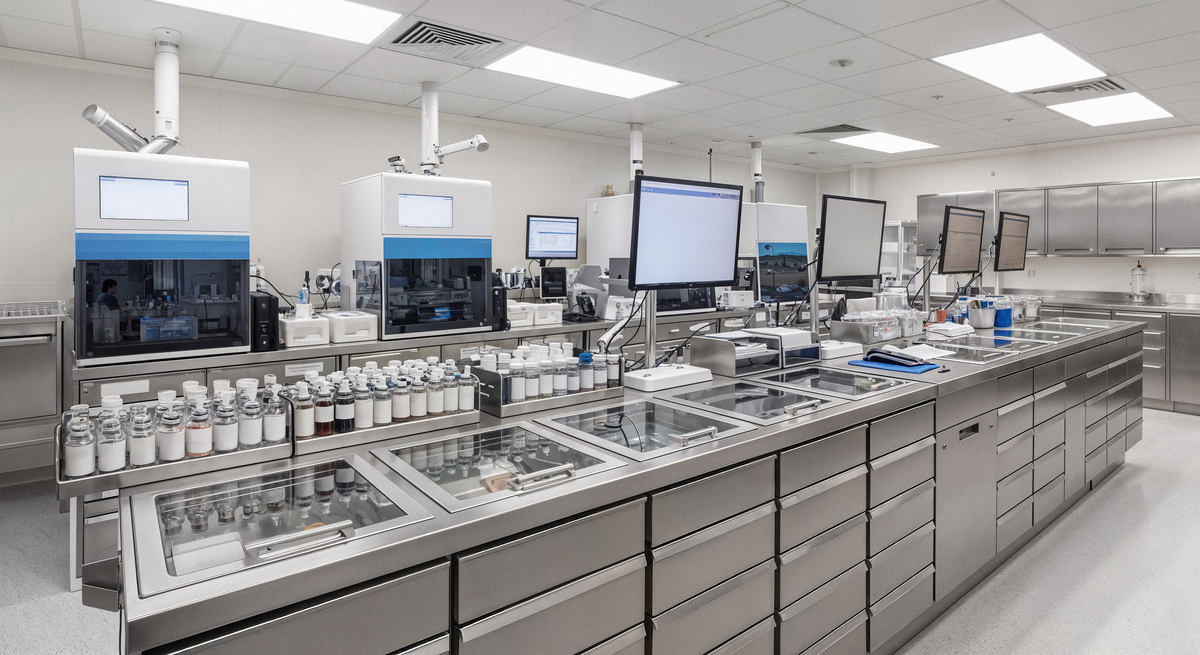
Managing chemical secondary containment is fundamentally a compliance assurance task. It requires the right equipment to ensure your facility meets the strict requirements mandated by local governing bodies and minimizes operational risks. This includes everything from simple spill pallets to complex strategies for sizing neutralization and disposal systems.
As a trusted lab equipment distributor, IT Tech provides a complete solution for your laboratory safety. We supply appropriate hazardous material storage solutions and lithium-ion battery cabinets alongside a comprehensive range of laboratory biosafety cabinets, safety cabinets, and gas piping installation and distribution systems. Our expertise helps facilities navigate complex procurement needs to ensure total safety.
Reach out to our experts today for your laboratory hazardous material storage needs.
Products You may Like
Check out other IT- Tech product that suit your taste
Subscribe to our newsletter
Stay updated with IT-Tech Insights
Related posts
Check out other IT- Tech Scientific Resources